

To evaluate an oil and gas investment deal effectively, many accredited investors use a four-pillar framework: operator track record, geological data, well economics at conservative pricing, and risk-factor sensitivity.
This framework replaces “gut feelings” with a repeatable, structured method. Operators with a multi-well documented track record, geology supported by relevant reports, well economics that hold up at meaningfully lower prices, and acceptable sensitivity to drilling, commodity, and operating-cost stress are the deals that plausibly justify investment.
This article expands on each pillar in detail, while the comprehensive Investor Guide offers a broader look at the principles and mechanics of U.S. oil and gas investing, downloadable here.
Why a Structured Framework Matters
Investors who succeed in this asset class have a structured approach to evaluating deals. A consistent framework forces attention toward the variables that matter and prevents analysis from being substituted for a feel-good narrative
Pillar 1: Operator Track Record
Arguably, the single most important variable in any oil and gas investment is the operator. The same geology, drilled by two different operators, can produce materially different outcomes. Evaluation should therefore start here.
What to look for.
- Multi-well documented track record. A clear history of completed wells with documented production performance. Five or more recent wells in the relevant basin is a useful starting threshold for assessment.
- Performance versus prior projections. This is the most important comparison. Does the operator’s communicated projection in earlier deals match what those deals actually produced?
- Basin-specific experience. Operating in the relevant formation matters. A capable Bakken operator may not be the right operator for a Permian Wolfcamp project.
- Service-company relationships. Established access to drilling rigs, frac crews, sand suppliers, and water-handling capacity matters in tight service markets.
- Internal teams. Engineering, geological, and land teams retain valuable experience and knowledge from one project to the next. Operators that outsource these functions can be more vulnerable to turnover and continuity challenges.
- Operator co-investment. Capital committed by the operator alongside outside investor capital is the single strongest alignment signal. Operators with capital at risk make different decisions from those without.
When to take caution
- When operators have limited public track records or track records dominated by promotional materials rather than production data.
- When operators communicated projections in prior deals that materially overstated actual outcomes.
- When operators are new to the basin or formation, particularly when offered as a “first deal in the new play”.
- Operators with no co-investment alongside external capital.
These cautions do not automatically disqualify a deal, but they do warrant enhanced deliberation.
Pillar 2: Geological Data
Geology is the second pillar. Even the best operator cannot produce oil and gas from a poor reservoir. Here, evaluation is about evidence: what data supports the projection that this specific well, drilled at this specific location, will produce as expected?
What to look for.
- Nearby well data. Producing wells in close geographical proximity to the proposed location, in the same target formation, with documented production histories. The closer and more recent these wells, the higher the confidence in the projection.
- Productive thickness. Measured pay zone thickness, supported by log data (if possible). Thicker pay zones generally support better economics.
- Reservoir quality indicators. Pressure, permeability, and porosity, measured at nearby wells and inferred for the proposed location.
- Drilling and completion design. Lateral length, frac stage count, proppant loading, and fluid design, all calibrated to what has worked in nearby wells.
- Independent reserves estimates. Where available, estimates from a qualified third party rather than relying solely on the operator’s internal projections.
When to take caution
- When projections are supported only by basin-wide averages rather than nearby well data.
- When “Frontier” locations are significantly further outside the established core of a producing area.
- When designs are significantly different from what has succeeded in nearby wells.
Pillar 3: Well Economics at Conservative Pricing
The third pillar is the financial side of the evaluation: does the deal generate acceptable returns at conservative price assumptions, not just at optimistic forecasts?
What to look for.
- Break-even pricing. The realized oil and gas prices at which the well’s net present value (NPV) reaches zero. While a lower break-even price is preferable, a meaningful buffer below current and forecast prices is essential for reducing risk.
- Payback period. Months or years required for cumulative net distributions to recover the original capital. Evaluate the projected payback period and the assumptions behind it; actual payback varies widely and cannot be assured.
- Internal rate of return at conservative pricing. IRR based on lower-than-market price assumptions is generally more reliable than headline strip-price IRR
- Cash-on-cash multiple over the well’s life. Total distributions divided by capital, undiscounted. Assess the projected cash-on-cash multiple and the assumptions behind it; actual multiples vary widely and cannot be assured.
- Cost structure transparency. Clearly disclosed AFE, operating costs, severance taxes, and management fees are clearly outlined instead of being bundled up into a single opaque number.
When to take caution:
- When headline IRRs depend on optimistic price assumptions or rapid production ramps.
- When there are cost structures with bundled or undisclosed management fees.
- Economics with no margin of safety against a 25% price decline from current levels.
- Project structures with capital-call mechanics that aren’t clearly disclosed.
Pillar 4: Risk-Factor Sensitivity
The fourth pillar tests how the deal performs under realistic adverse scenarios. The standard sensitivities every investor should run:
Production sensitivity. What happens to returns if production comes in 15% below projection? 20%? 25%?
Price sensitivity. What happens if realized prices average 25% below current spot over the well’s life? 35%?
Cost sensitivity. What happens if operating costs run 20% above the operator’s estimate?
Differential sensitivity. What happens if local basis differentials widen significantly during periods of takeaway constraint?
Combined sensitivity. What happens under a scenario combining adverse production and pricing? This is the most realistic test, since adverse scenarios often correlate.
A deal that holds up reasonably well under multiple stresses is more durable than one that depends on a specific scenario to go exactly as expected. The most useful single number from this exercise is the IRR under a “downside but realistic” combined scenario.
Putting the Framework Together
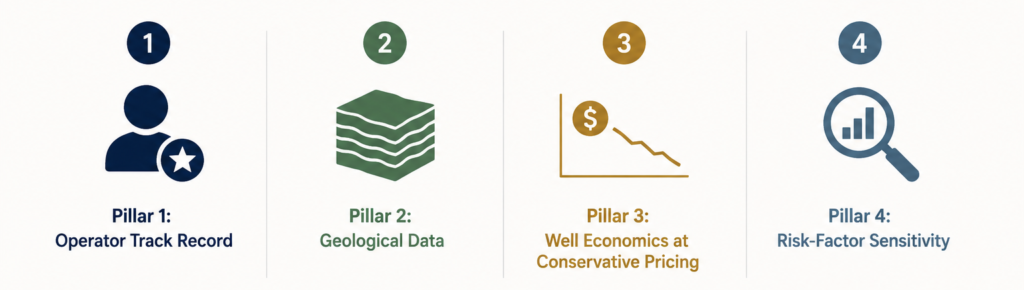
When all four pillars line up, a strong operator with a documented track record and co-investment, geology supported by nearby well data, economics with a margin of safety at conservative pricing, and acceptable performance under stress, the deal merits serious consideration.
When one pillar is weak, the deal requires either compensating strength elsewhere or higher caution. A weaker operator can sometimes be balanced by exceptional geology and operator co-investment; a thin offset data set requires either more conservative pricing or lower allocation sizing.
When two or more pillars are weak, sophisticated investors generally pass. There are always more deals to consider when one falls short. Always.
Common Evaluation Mistakes
- Anchoring on headline IRR. A projected IRR is a function of assumptions. Investors who focus only on the headline number often disregard the assumptions that produced it.
- Skipping operator due diligence. Geology and economics matter, but operator quality matters more.
- Committing to a single deal. Even disciplined evaluation produces variable single-deal outcomes. A diversified portfolio of well-evaluated positions is more resilient than concentration in a single perfect-looking deal.
- Ignoring after-tax economics. For high-income investors, the IDC, depreciation, and depletion provisions can materially change the after-tax outcome, and, as a result, the deal-evaluation conclusion.
Frequently Asked Questions
How do I evaluate an oil and gas investment deal?+−
What’s the most important variable to evaluate?+−
How do I evaluate the geology?+−
How do I stress-test economics?+−
Should I rely on the operator’s IRR projection?+−
Deal Evaluation with Sovereign Energy Partners

Sovereign Energy Partners is a US-focused energy investment platform and a subsidiary of Consolidated Energy Holdings, a UK-headquartered energy and natural resources group.
Sovereign Energy Partners provides accredited investors structured access to upstream US oil and gas opportunities, with a focus on operator alignment, transparent deal evaluation, and education-led investor relationships.
Free Investor Guide
Your complete guide to U.S. oil and gas investing
Download our complete and illuminating Investor Guide to learn everything there is to know about investing in the U.S. oil and gas industry.
Disclaimer
This article is for educational purposes only and does not constitute investment, legal, or tax advice. Oil and gas investments involve risk, including the potential loss of principal. Tax treatment varies by individual circumstances.
Consult your tax advisor before making any investment decisions. Securities described are offered only to verified accredited investors under applicable SEC exemptions.